
Fiction by Kenneth Gulotta
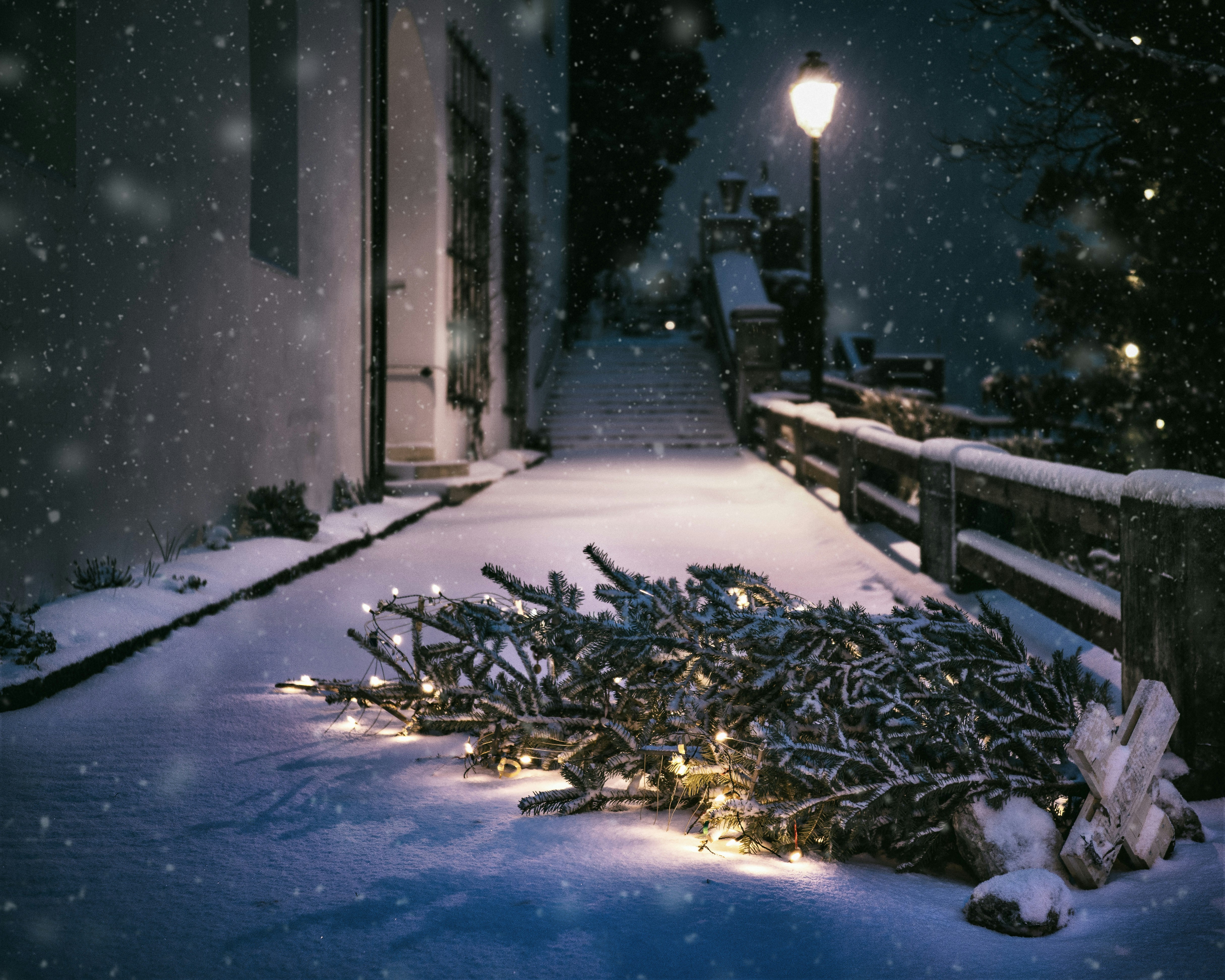
Jesse had found a ball of twine next to the dumpster, and he and Frankie were using it to tie the Christmas trees to each other, bottom to tip, in a ring around the top of the dirt pile. Some of the trees were turning brown, and their needles fell as the boys reached through them to wind the twine around the rough, sappy branches and trunks; others were still green, and many of their needles clung to the branches, obscuring the lines and knots of the twine.
“I wonder why some of ’em are falling apart so bad but others aren’t,” Frankie said, standing in the middle of the circle, a bird in a nest. “There’s only one Christmas, right? They should all be about as old as each other.”
Jesse pulled the twine, gripping the diminished ball, tightening the last knot. He bent and bit at the twine, sawing it against his front teeth until the fibers separated, and then he dropped the ball. It rolled down the side of the little hill of dirt, leaving a twitching tail of string. He shrugged. “Some people take care of them, change the water and add the preservative stuff to it, and some people just ignore them. Doesn’t matter. They’re all cut down and dead to begin with. The green ones just lasted longer, like on life support.”
“God, Jesse!” Frankie laughed. “I mean, morbid, man! What’s the matter, you don’t like Christmas trees or something?”
Jesse hitched his leg over one of the greener trees and climbed into the nest. “I don’t like or dislike them,” he said. “I just don’t see the point of them.”
“Presents! Presents are the point!”
“You can get presents without having a tree. You don’t have a tree at your birthday.”
“Well, at Christmas, presents go under the tree. You don’t want to get stuff for Christmas?”
“I’ll take Christmas presents, and if there has to be a tree to get them, well, okay. But I still don’t understand why there has to be one—I still don’t think there does. It’s just—people doing things because they do them that way.”
“Well, did your mom get a tree this year?”
“Fake one. She didn’t have to get it—she just hauled it out of the closet.”
“Real ones are better.”
“Well, I think they’re stupid, but at least we’ve got this crow’s nest thanks to them, and we’ll see Justin coming like a million years before he even knows we’re here.”
“Yeah.”
“What the hell are you boys doing up there?” someone called behind them, near the dumpsters, growling.
The boys spun. The handyman sauntered from the packed earth next to the dumpsters onto the grass of the field. He stopped near the bottom of the dirt hill.
“Nothing,” Jesse said.
“Well, what’s with all those trees?” the man asked. “Those got left by the garbage bins for a reason, you know. Tomorrow’s pickup day.”
“Oh, come on, Curtis!” Jesse spat. “We weren’t doing anything. We aren’t hurting the trees. They’re already used, anyway. I mean, look at them: they’re falling apart. They’re just garbage. We’ll put them back.”
“We’re just playing, Mr. Fontenot,” Frankie said. “We’ll put everything back when we’re done.”
The man shook his head. “That’s a fire hazard up there,” he said. “The apartments could be liable if anything happened.”
“They’re still the same fire hazard over by the dumpsters, Curtis,” Jesse said. “Even more of one. Up here, there’s nothing else around them to burn. Why does it even matter? Anyway, does this field even belong to the complex? I thought that new Italian restaurant was going here. Why are those dumpsters on their field in the first place?”
“That’s not my business and it’s none of yours, either. Now, I got to go, but when I come back tonight I want to see everything back where it’s supposed to be. I don’t want those things sitting around all week getting full up with vermin. Understand?”
Jesse pulled some needles from a tree and let them drift down and sideways in the wind.
“We’ll put it all back, Mr. Fontenot,” Frankie said.
“You better. Otherwise, I have to talk to the manager, and he has to talk to your parents, and, who knows, maybe he decides to fine them or something.”
“Fine them for what?” Jesse asked.
Curtis chewed his lip, and then he said, “Improper refuse disposal. Now, that’s in the leases, I’m sure of it. So, you get everything back in place today before I get back.”
“Tonight,” Jesse said. “You get back tonight, you said.”
Curtis shook his head, and then he turned and stalked away, into the parking lot and between the buildings, out of sight.
Jesse turned to Frankie. “We’ll put it all back, Mr. Fontenot,” he mimicked.
“Shut up,” Frankie said. “You were just making him madder.” He reached down and started pulling at one of the knots of twine.
“What the hell are you doing?” Jesse demanded.
“What? You heard what he said. We’ve got to stick everything back where we found it, or he’s gonna complain to our parents.”
“Oh, bull. He was just saying that to scare us. Besides, if he complains to my mom, she’ll just think he’s trying to get back at her for not going out with him, even though he’s asked her about eight hundred times.”
“Well, what about that fine thing he was talking about? What if the apartment bosses fine our parents for something we did? My dad’ll whip my ass sideways if he gets charged because we decided to make a fort out of a bunch of Christmas trees.”
“That was just some bullshit he was making up. He doesn’t know what it says in the leases—he doesn’t even have a lease. He gets a crappy little studio as part of his job, I heard him tell my mom one day. Besides, how could the apartment complex owners charge us with ‘improper refuse’ or whatever, when this isn’t even their property? We didn’t leave refuse on their property, we took it off their property. If anyone was going to charge us with anything, it’d be the Italian restaurant people, and they don’t care, because all they’ve done so far is clear the brush out of the field—there’s nothing out here for us to hurt.”
“I don’t know.”
“Anyway, none of that matters, even, because we’re going to clear it all up by the time Curtis gets back. He said tonight, and it doesn’t get dark for another two hours. So we’ve got plenty of time to ambush Justin and haul everything back by the dumpsters before Curtis drags his sloppy butt back around to check.” He knelt on the dirt hill, ducking behind the ring of trees. “Come on, get down, in case Justin comes by.” He dug in his pockets and pulled out an assortment of pale blue and red firecrackers, slightly bent. He straightened the fuses on a couple, and then he looked up at Frankie. “Come on, duck down!”
Frankie squatted in the circle of trees, and then he sat back and crossed his legs.
“I’ve got some regular firecrackers, some bangers I mean, and I’ve also got some jumping jacks here, just to keep him mixed up a little,” Jesse said. “What’d you bring?”
“I couldn’t get any.”
“What? What the hell, Frankie?”
“My dad locked them up!” Frankie protested. “So me and Mike could only set them off when he was around to watch. To supervise.”
“Supervise. Jesus.” He counted the firecrackers, sorting them into two piles on the dirt. “Okay. Eleven bangers and eight jumping jacks.” He shook his head. “Well, it’s probably enough.” He dug in his other pocket and pulled out a box of kitchen matches. “At least the trees will keep the wind off. Now, since we don’t have much ammunition, we’re going to have to wait until he’s really close—just keep real still and wait for him to come right up to the bottom of the hill, and then we’ll light up and let loose at him.” He frowned. “We need some peepholes, to see when he’s coming.” He poked at some of the brown needles, brushing them away and making a rough tunnel through them. “Make one on that side,” he told Frankie. He turned to the left, toward the dumpsters, and started digging another hole through the needles. “Not too big,” he said, glancing back at Frankie, who was twisting his arm in a circle, grinding it against the branches.
“How do we even know Justin is going to come by here?” Frankie asked.
“He always comes by the day before trash day,” Jesse said. He sat back and began rearranging the firecrackers. He laid a row of matches down and set the matchbox on the dirt next to them. “He likes to check for stuff people might be throwing out.”
Frankie sat back down. “What kind of stuff?”
“People here throw out all kinds of shit that isn’t really trash or broken. When they’re moving out, they just drag things over to the dumpster if they don’t feel like hauling them around or taking the time to sell them. Like, he got some furniture, chairs and stuff, that looked just about brand-new, but he also finds toys and stuff. He got one of those toy football games, with the vibrating field, that hadn’t even been opened, and once he got a bicycle that just needed new tires. He’s still got that bicycle. The football game he sold to some kid. But his apartment’s full of crap he’s dug out of these dumpsters.” He looked up at the sunny sky. “I wish it would get cold and stay cold for a while. You can hardly tell that it’s winter.”
“I like it warm. I wish it would just stay sunny out.”
“Well, in a few months we’re going to have more sun than you’ll know what to do with. It’s going to be nothing but sun. If they’d put air conditioning in at school, it wouldn’t be so bad. They must not want us to be able to think. To learn. Not really.”
“Jesse?”
“Yeah?”
“Why’d you come up with this? I mean, I know why I’m mad at Justin. But how come you thought up a way to get back at him?”
“What do you care? What, you don’t want to scare him after that thing with the dog crap?”
“No, I do, I want to get him. I just—it wasn’t your shirt that he rubbed it on. I’m just wondering what he did to you, is all.”
“That kid is a psycho. I don’t like guys like that. So I thought of a way to scare him into crapping his pants. So maybe he’ll leave everybody alone.”
“Oh. Okay.”
Jesse adjusted the line of firecrackers again, and then he said, “He called my mom a slut, okay?”
“What? He said that to you?”
“No, he didn’t say it to me. He and one of his shitty little friends—that guy with that weird welt on the side of his neck—they were walking past the stairs in my building, and they didn’t know I was sitting up at the top of them, and Justin said to the other kid, ‘You want to get your dick wet, just go knock on that Miller lady’s door—she’s opened up for half the guys in the complex.’”
“What an asshole. What did you do?”
“I just sat up there and listened while they walked away laughing. I just sat like a puss without saying a word, like a nothing.”
“Oh. But he was lying, right?”
“Of course he was lying, goddamnit!”
Frankie shook his head. “You should’ve just yelled at him right there. He wouldn’t’ve been able to say anything back—his mom’s on her, what, third husband now?”
“I know what I should have done, but I didn’t do it. So that’s why I’m doing this now.”
“Maybe he’ll cry.”
“I hope so. Asshole.”
“If he does cry, I’m laughing my ass off.”
“Yeah. So, look, when I tell you, you light a match and just hold it still for me to light the firecrackers and throw them. Just keep lighting matches and letting them burn down until it’s over. That way, we can keep the pressure on him, just keep attacking without having to stop.”
“We could take turns—one of us lights a match and throws, and then the other lights up when the first guy’s match burns out.”
Jesse shook his head. “Too complicated. This way, we just have one job each to worry about, and we don’t have to keep timing everything we do against each other.”
“Why do you get to be the one who throws, then?”
“They’re my firecrackers, remember? You didn’t bring anything, which means we’re low on ammunition to start with, so we have to make every shot count.”
“Okay, okay.” Frankie picked up the matchbox and shook it close to his ear, listening to the dull, dry-boned rattle.
Jesse peered through one of the rough peepholes in the tree ring. “Stop!” he hissed at Frankie. Then he muttered, “I see him coming.” He pulled back from the peephole and picked up two of the firecrackers and two of the jumping jacks. He held the two firecrackers in his right hand, with the fuses touching. “Wait until I say,” he said. He crouched before the peephole again.
Frankie spilled the matches onto the dirt. He picked one up. He held it in one hand and the empty matchbox in the other, and then he kept his eyes on Jesse, who was absently mouthing the word “wait” again and again.
“Now!” he breathed, turning to Frankie and holding out the firecrackers.
Frankie scraped the match against the box, once, twice, and then held the quivering flame out to Jesse. The burning match danced around the firecrackers as Frankie’s hand continued to shake. He steadied it on the wrist of his other hand, and Jesse dipped the fuses into the flame. He glanced through the peephole, looked at the burning fuses, and then lobbed the firecrackers over the ring of trees.
The pops overlapped, but they were slightly out of sync: pohpop!
“Whoa fuck!” Justin yelled from the ground. Jesse was already lighting the fuses for the jumping jacks. “Next match!” he hissed to Frankie. He stood, looking down from his ring on the hill, and threw the jumping jacks at Justin’s feet. They squealed and began spinning and bouncing, throwing off twists of green and gold sparks. Justin danced sideways, away from them.
“Yeah, fucker!” Jesse yelled. “Maybe you’ll learn to keep your mouth shut about people!” He started to bend to grab more fireworks, but he froze when he saw Frankie scrabbling with his left hand in the dirt for a new match and letting his right hand, which was holding the shriveled but still-burning first match, drift sideways into the brown, crisp needles of one of the Christmas trees.
“Watch it, Frankie!” Jesse sputtered as the needles caught fire. The flame puckered and spread rapidly, running along the dry branches and throwing white smoke upward.
Jesse looked at Justin, whose mouth was hanging loose, his tongue pressing down against his lower lip, like a dog trying to pant. He took several steps backward, his eyes growing wider as the flames in the tree ring grew higher, and then he spun and ran the length of the parking lot. At its end, he turned right, disappearing into the gap between the building and the row of trees lining the drainage ditch next to the highway.
“Shit,” Jesse said. He tugged the twine at one end of the burning tree. “Undo the other end,” he said, but Frankie was scooting backwards against the other side of the ring. The twine came loose, and the burning tree rolled in an arc downward, turning toward the side that was still tied, swinging by its tip around the hill. The tip broke off and the burning tree rolled the rest of the way down the hill and stopped in the dirt a few feet from its base.
“Okay, that works,” Jesse said. He inspected the two Christmas trees that had supported the burning one. They seemed intact; they weren’t smoking, at least. He slid down the hill and stomped on the remains of the burning tree. It was mostly out, anyway: the needles had burned away quickly, and the fire that had reached the branches had died down when the tree rolled down the pile of dirt.
He stopped stomping and inspected the remains. A spark still glowed at the end of one branch. Jesse stepped on it, twisting his shoe into the ground beneath. He swung his arm up and wiped the sweat from his face with his sleeve.
He climbed back up the dirt pile. The gap left by the missing tree in the ring grew wider as he climbed, and then the remaining trees rolled away, down the other side of the dirt hill. Most of the trees stayed tied together, but one broke free and rolled off on its own. Frankie remained at the top of the mound, exposed, sitting with his knees near his chin and his hands over his mouth.
“I’m sorry,” he quavered. “I didn’t—I didn’t mean—”
“It’s okay,” Jesse said. “It’s no big deal. Actually, I think we really scared him. He ran off by the highway. Looked like he was running to the next town.”
“We’re going to get into so much trouble,” Frankie said. “He said—he said it was a fire hazard, and then I went and set it on fire.”
“No, come on, Frankie, we didn’t hurt anything. We burned up one old Christmas tree. It’s out now. I stomped it completely out. All we have to do is put the trees back, like we said, and we’ll just put that one at the bottom of the pile, or in the middle of the pile. We’ll just hide it with the other trees, and everything will be fine.”
Frankie shook his head, his mouth moving behind his clutched hands. “They’ll find out,” he said. “They’ll find the burn marks, or someone saw it and they’ll tell, or Justin’ll tell.”
“Justin isn’t saying anything. Justin is running home to change his pants, is all he’s doing.”
Frankie stood up. He brushed pine needles and dirt from his jeans. “We have to confess,” he said. “I have to confess. If I don’t, and my dad finds out, he’ll kill me.”
“Frankie, don’t get all Catholic and bullshit here. You can’t go telling on yourself for no reason.”
“I have to.”
“Look, we didn’t hurt anything, man.”
“I have to tell my dad before he finds out.”
“That doesn’t make any fucking sense, Frankie! Jesus! Your dad hates me already, and if he goes complaining to the manager about me—look, Frankie. I mean it. If you say anything to anyone, I’m going to beat the shit out of you. I will. I mean it.”
Frankie drew back a step, his eyes glistening and black. Then he spat, “Well, I’ll tell everybody the truth about what Justin said. I’ll tell everybody, everybody here and at school, about all those guys at your house all last year, all those guys your mom has been fucking—”
Jesse stepped forward and swung. At the last second he opened his fingers, hitting Frankie on the side of his face with a loose hand rather than a fist, but Frankie still stumbled down the dirt hill.
At the bottom, he looked up at Jesse, holding his cheek. He ran around the mound of dirt, his head dipping forward as he started sobbing and tried to hide it. Jesse watched him stumble across the parking lot. He ran into the cluster of buildings. At the sidewalk that led to his own building, he kept going straight—he was heading to the playground, maybe, or to that big willow tree he liked to hide under. Or maybe he was just running, and he would still loop home, crying, in the end, and then Jesse’s mother would be getting the phone calls again.
Jesse stood on the little hill for a few minutes, looking at the apartment buildings, with their brick bases and upper stories of white wood, at the empty field, where there would one day be an Italian restaurant, at the highway, where cars were starting to groan as people headed home from work.
He skidded down the hill. He grabbed the loose tree and dragged it next to the dumpster, and then he gathered the remains of the burnt tree and dropped them on the loose tree. He went and grabbed the middle tree in the set of three that were still tied together, and he hauled them all to the dumpster, where he piled them on top of the others, hiding the black tendrils of the burnt tree.
He climbed back to the top of the hill and gathered the unused fireworks, the empty matchbox, and the bit of burnt matchstick and remaining unlit matches. He shoved everything in his pockets, and then he scuffed the dirt at the top of the pile, hiding the fragments of burnt needles. He slid down the hill again and scraped dirt over the ashes and burnt fragments at its base. He stood for a minute, looking around and making sure he hadn’t missed anything. Then he turned away from the hill and crossed the parking lot. In the fading light, he walked between apartment buildings. He stepped slowly on each square of sidewalk, traveling in straight lines and right angles, gradually making his way to the apartment where he and his mother lived.
Kenneth Gulotta writes fiction and poetry. A technical writer by trade, he spends his days solving puzzles that involve communication, design, and coding. Kenneth has an MA in creative writing from UT-Austin and a PhD in English from Tulane University. He lives in New Orleans with his wife and stepson. His fiction has been published in Red Rock Review, Identity Theory, Cottonwood, and the Queen’s Quarterly. He can be found at kennethgulotta.com.
Photo by Simon Berger on Unsplash
 Random Sample Review